
Renters’ Rights Act: Local Authority Enforcement 2026
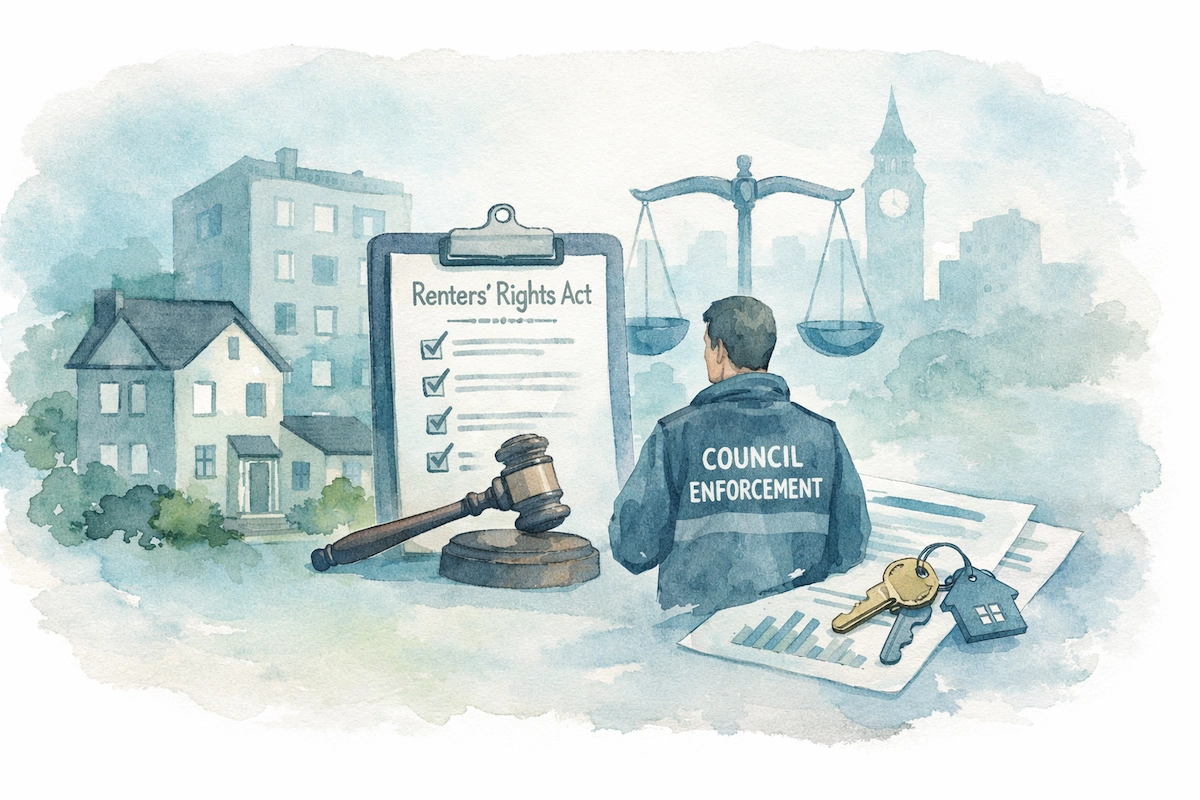
Enforcement escalation: Councils now audit. Penalties up to £40,000.
Time to read: 2 minutes
From 1 May 2026, local housing authorities in England operate under a significantly different enforcement framework. The Renters’ Rights Act 2025 converts council enforcement of rental standards from a discretionary function into a statutory duty. The consequences for property operators are direct and immediate.
A Self-Funding Enforcement Model
The Act has structured council enforcement to be partly self-financing. Civil penalties collected through enforcement activity feed back into local authority budgets, creating a financial incentive for sustained investigatory action. Councils are no longer dependent on external resource allocation to pursue non-compliant operators. The enforcement landscape has shifted from reactive to institutional.
Expanded Investigatory Powers
The Act grants local authorities investigatory powers modelled on trading standards. These go beyond individual property inspections. Councils can enter business premises to access tenancy agreements, digital communications, and financial records. They can also require financial data directly from banks, accountants, and client money protection schemes without operator involvement. These powers allow councils to audit an operator’s entire portfolio, not just a single property.
For certain breaches including illegal rental bidding and discrimination against families or benefit recipients the evidential threshold is the balance of probabilities. This is a civil, not criminal, standard. Councils do not need to build a criminal-standard case to issue a substantial penalty.
The Penalty Framework from May 2026
Civil penalties replace criminal prosecution as the primary enforcement tool. Initial or minor breaches carry penalties of up to £7,000. Serious, repeat, or criminal breaches attract fines of up to £40,000. The Act extends Rent Repayment Orders to a maximum of 24 months’ rent, with a matching 24-month application window for tenants.
Penalty calculations apply a totality principle that accounts for financial benefit derived from a breach. A fine may therefore exceed what appears proportionate to the incident if non-compliance has been profitable. RRO liability now extends to superior landlords and company directors personally. Corporate portfolio structures no longer provide a shield against personal financial liability.
Section 21 and the Transition to Section 8
The abolition of Section 21 takes effect on 1 May 2026 for all tenancies. The regime moves entirely to Section 8 an evidence-based possession system in which every claim requires a documented, provable ground. A 12-month protected period applies at the start of every tenancy, during which the most commonly used grounds: selling a property and landlord occupation are unavailable.
Phase Structure
The transition operates in phases. Phase 1 the shift to rolling periodic tenancies and the abolition of Section 21 takes effect from 1 May 2026. The mandatory Private Rented Sector Database and Ombudsman requirements are expected to follow in a second phase, currently scheduled for late 2026 or early 2027. Once live, a Unique Identifier from the PRS Database will be required in all property listings.
Further reading:
Renters’ Rights Act: Local Authority Enforcement 2026