
Renters’ Rights Act: Local Authority Enforcement and Compliance Requirements

Time to read: 5 minutes
Key takeaway
From 1 May 2026, the relationship between landlords and local housing authorities changes fundamentally. The Renters’ Rights Act 2025 shifts enforcement from discretionary to mandatory — and that shift carries real financial and operational consequences for anyone running a rental portfolio.
This guide explains what the new enforcement framework means in practice, what powers councils now hold, and how to structure your operations to remain audit-ready.
The Enforcement Landscape Has Changed
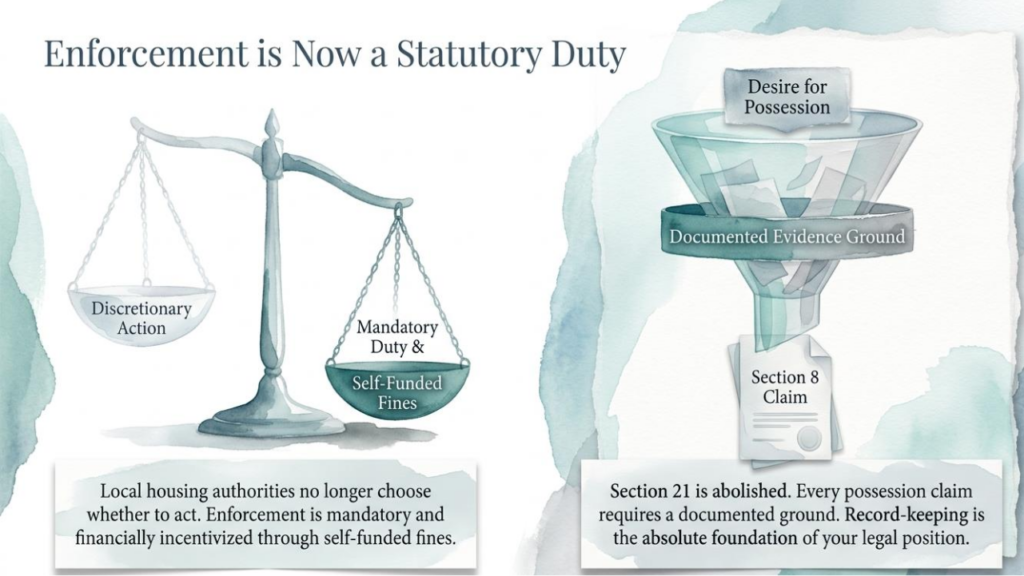
Local authorities are no longer choosing whether to act. Under the new regime, enforcement of rental standards is a statutory duty. Councils have been equipped with broader investigatory powers and a clear financial incentive: enforcement activity is now partly self-funded through the fines it generates.
For property operators, this is a structural shift worth understanding clearly. The Act is designed to remove low-standard operators from the market. For those running compliant, well-managed portfolios, it creates a more stable, transparent operating environment. That advantage only materialises if your documentation and processes can withstand scrutiny.
The removal of Section 21 is the headline change. What it means operationally is a full transition to Section 8 — a purely evidence-based possession system. Every possession claim now requires a documented, provable ground. Your record-keeping is now the foundation of your legal position.
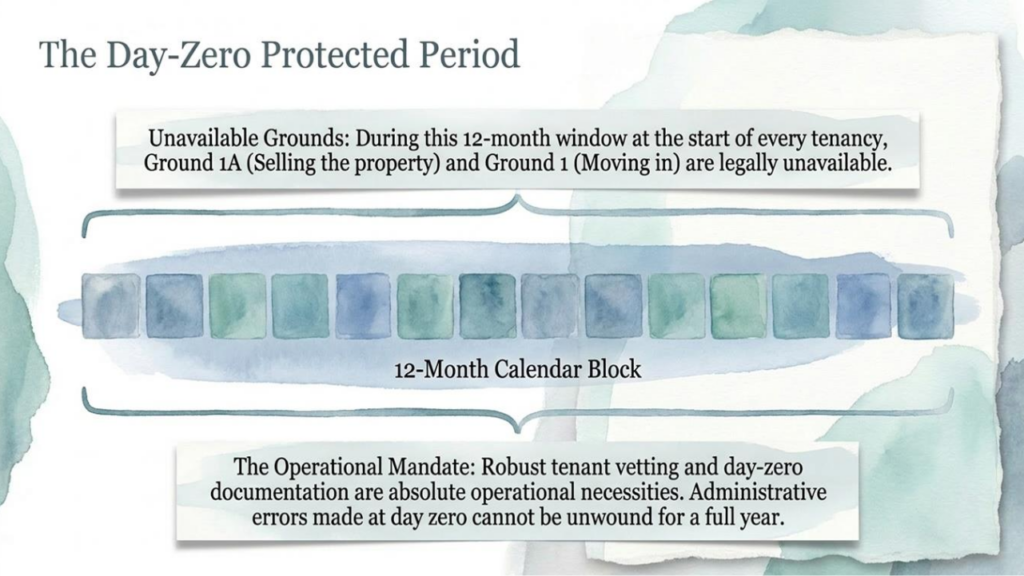
| The 12-Month Protected PeriodA protected period applies at the start of every tenancy. During this window, the two most commonly used possession grounds — selling the property (Ground 1A) and moving in (Ground 1) — are unavailable. Robust tenant vetting and day-zero documentation are no longer administrative preferences. They are operational necessities. |
What Councils Can Now Do
Local housing authorities have been granted investigatory powers modelled on trading standards. These go beyond inspecting individual properties — they allow councils to audit how you run your business as a whole.
Three powers are particularly significant:
Power of Entry
Councils can enter business premises and, in specific circumstances, residential premises to obtain evidence — including tenancy agreements, digital communications, and financial records.
Third-Party Information Requests
Councils can now require financial data directly from banks, accountants, and client money protection schemes, without involving you, to build a compliance picture of your operations.
Graduated Standards of Proof
For certain breaches — including illegal rental bidding and discrimination against families or benefit recipients — the threshold is the balance of probabilities. For breaches relating to the PRS Database and the Ombudsman, the standard is beyond reasonable doubt.
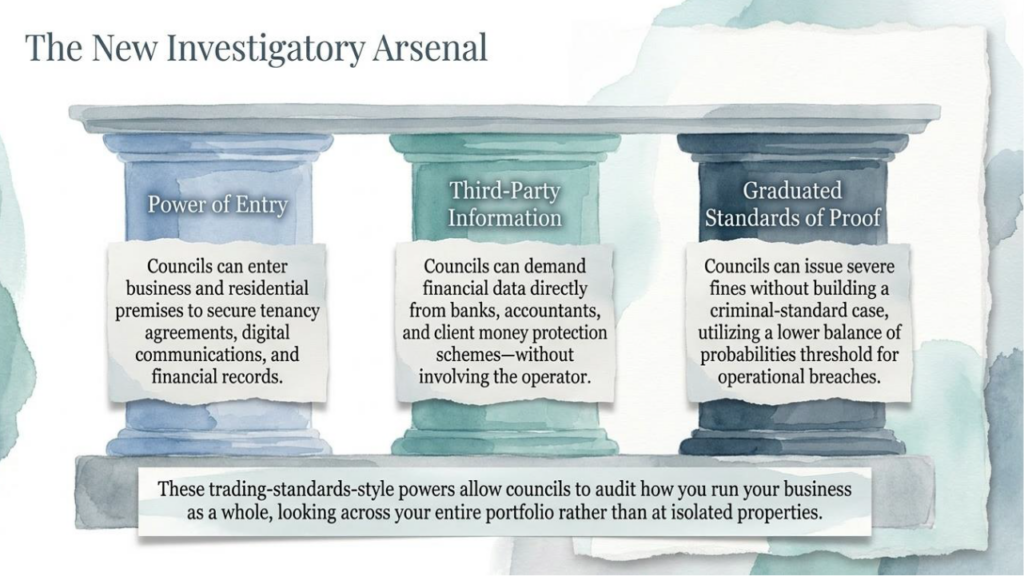
| Why the Lower Threshold MattersThe balance of probabilities standard means a council does not need to build a criminal-standard case to issue a substantial fine. Your marketing, screening, and tenant selection processes need to reflect this. These powers also allow councils to look across your portfolio, not just at a single property — so inconsistent or informal systems carry more exposure than structured, evidenced ones. |
The Financial Stakes
The Act gives local authorities the power to issue civil penalties as an alternative to criminal prosecution. The penalty framework from May 2026 is as follows:
| Breach Type | Maximum Penalty |
| Initial or minor breaches | Up to £7,000 |
| Serious, repeat, or criminal breaches | Up to £40,000 |
| Rent Repayment Orders (RROs) | Up to 24 months’ rent |
When calculating fines, councils apply a totality principle that includes the removal of financial benefit. A penalty is designed not just to punish but to eliminate any profit made from the breach. Fines can therefore exceed the apparent severity of the incident if non-compliance has been financially advantageous.
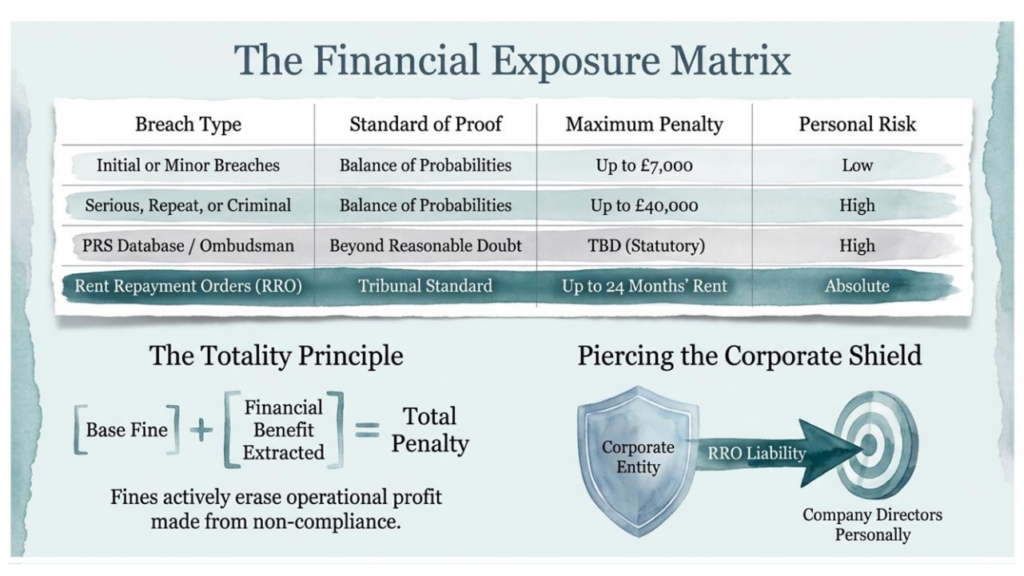
The extension of Rent Repayment Orders to 24 months — combined with a 24-month window for tenants to apply — substantially increases long-term exposure. Critically, RRO liability now extends to superior landlords and company directors personally. Structuring your portfolio through a corporate entity no longer provides a shield against personal financial liability.
Building a Digital Compliance Infrastructure
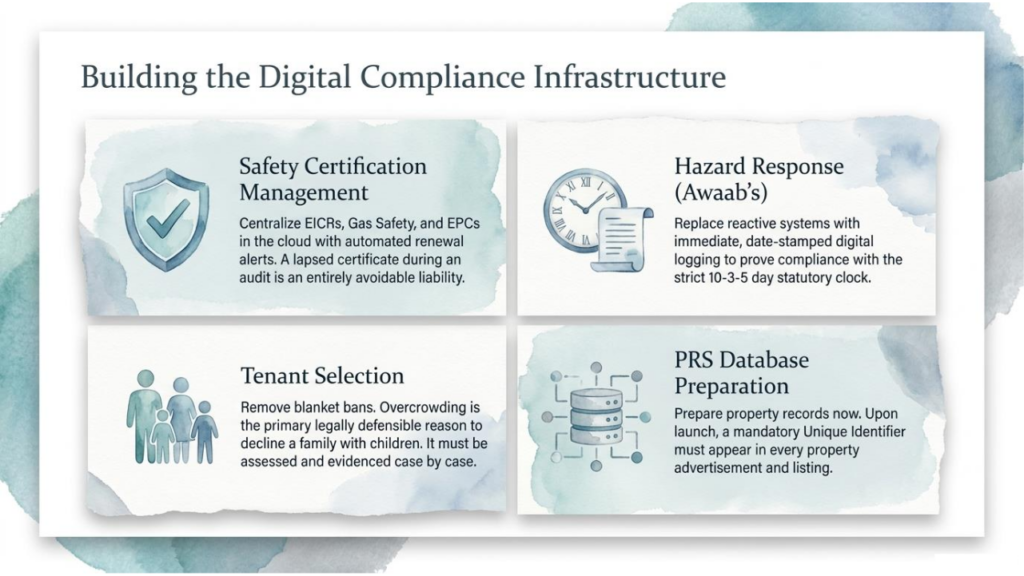
The operators best positioned for the new regime are those who have replaced paper-based, reactive systems with structured, digital processes. Property management software is no longer a productivity tool — it is the mechanism by which you demonstrate compliance. Four areas require immediate attention.
Safety Certification Management
Centralise all EICRs, Gas Safety Certificates, and EPCs in a cloud-based system with automated renewal alerts. A certificate discovered to have lapsed during an audit is a straightforward and entirely avoidable liability.
Hazard Response — Awaab’s Law
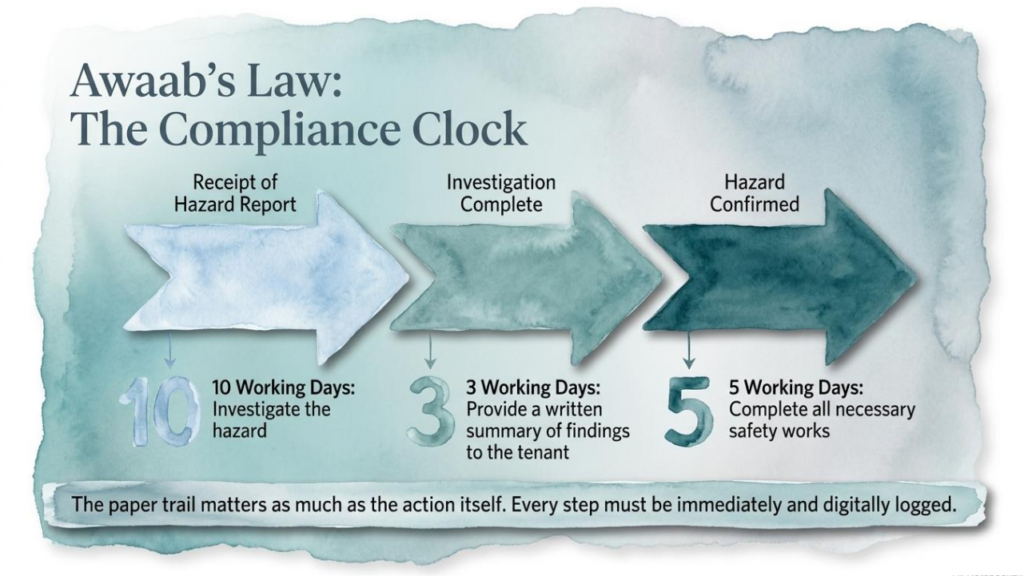
All damp, mould, and hazard reports must be logged immediately on receipt. The required response timeline is structured:
- Investigate within 10 working days of the report
- Provide a written summary of findings within 3 working days of completing that investigation
- Complete safety works within 5 working days of confirming a hazard
Document every step. The paper trail matters as much as the action itself.
Tenant Selection Compliance
Review your marketing and screening processes for any criteria that could constitute indirect discrimination against families or benefit recipients. Overcrowding is the primary legally defensible reason to decline a family with children — it must be assessed and evidenced case by case, not applied as a blanket policy.
PRS Database Preparation
All properties will need to be registered on the Private Rented Sector Database. Once live, your Unique Identifier must appear in every property advertisement and listing. Prepare your property records now so registration is straightforward when the database opens.
Operating with Confidence in the New Environment
The Renters’ Rights Act does not create an impossible compliance burden for operators who run structured, well-documented businesses. What it does is formalise the standards that serious operators should already be working towards.
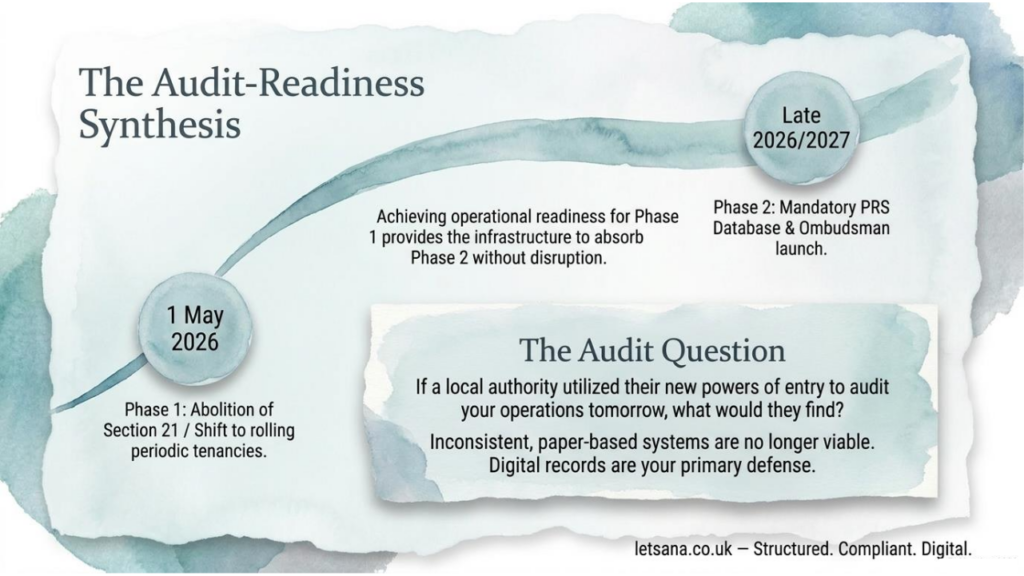
The transition is phased. The shift to rolling periodic tenancies and the abolition of Section 21 take effect from 1 May 2026. The mandatory PRS Database and Ombudsman requirements follow in a later phase, expected in late 2026 or early 2027. Achieving operational readiness for Phase 1 now gives you the infrastructure to absorb Phase 2 without disruption.
| The Audit Question: If a local authority audited your operations tomorrow, what would they find? The answer to that question determines your risk exposure under the new regime. Structured systems, digital records, and clear processes are not just good practice — they are your primary defence. |
Recommended reading:
The 2026 Renters’ Rights Reality: Preparing Your Portfolio for the New Regulatory Landscape
Take Quiz: Are You Ready for the 2026 Renters’ Rights Reforms?